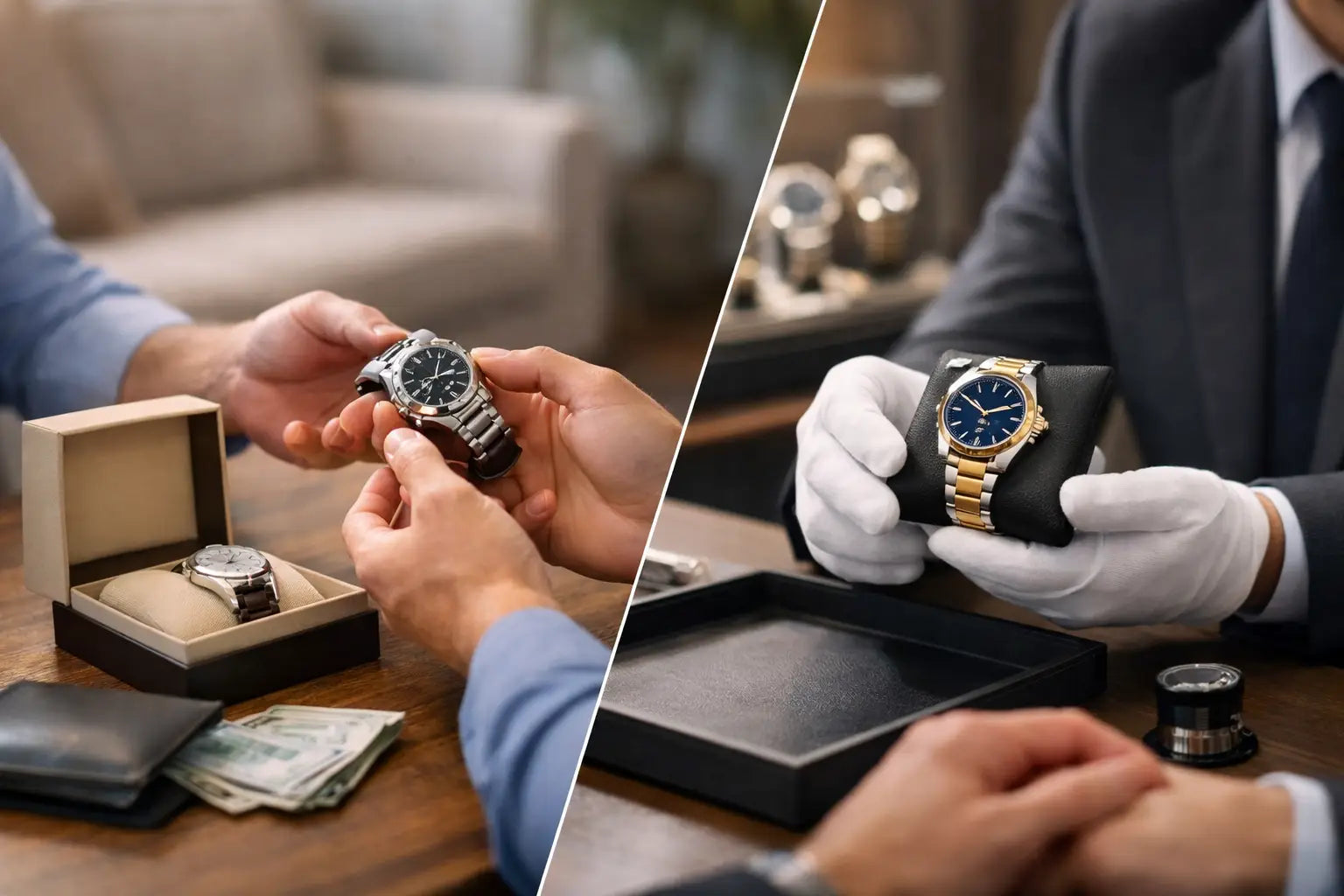
A private buyer offers £7,500 for your Rolex, then asks for more photos, wants proof of service history, and goes quiet for three days. A dealer offers £7,100, fully insured, with payment the same day. That gap is where most sellers get stuck. When comparing selling watches privately vs dealer, the real question is not just which route promises more, but which one leaves you with the best result after risk, time and fees are accounted for.
For some watches, a private sale can deliver a higher headline figure. For others, it creates weeks of messages, awkward negotiations and a genuine risk of fraud or disputes. A specialist dealer usually pays less than the very top private asking price, but the process is faster, cleaner and far more certain. Which option is right depends on the watch, your timeline and how much hassle you are prepared to absorb.
Selling watches privately vs dealer - what actually changes?
The biggest difference is not where the watch ends up. It is how the sale gets done.
Selling privately means you handle the listing, photographs, description, buyer communication, negotiation, payment checks and handover. If you are using a marketplace, you also deal with platform fees, buyer protection policies and the possibility of returns or chargebacks. If you find a buyer through a forum or social media group, you may avoid fees, but you take on even more responsibility for verifying who you are dealing with.
Selling to a dealer is a trade transaction. The watch is assessed, valued against live market demand, and bought directly if the offer is accepted. There is no public listing, no waiting for someone to commit and no debate after the watch has been received and authenticated under agreed terms. For many sellers, that certainty matters more than squeezing out the last possible pound.
Price is only one part of the equation
It is easy to focus on the highest number. That is often where private selling looks attractive. A sought-after Rolex Submariner, Omega Speedmaster or Tudor Black Bay may achieve a stronger gross price in a private sale than in a dealer purchase. That is because a private buyer is purchasing for personal ownership, while a dealer needs margin for servicing, warranty exposure, stock risk and resale costs.
But gross price and net result are not the same thing. Private marketplaces often charge selling fees. Payment processors may take a cut. Some buyers negotiate aggressively after agreeing a price. Others expect extras such as tracked delivery, insurance or a service record that was never part of the original deal. If a watch sits unsold for several weeks, the market can move against you as well.
A dealer offer is typically lower on paper, but it is clear and immediate. There are no seller fees, no advertising costs and no waiting for the right buyer to appear. If the dealer is a serious specialist rather than a general pawnbroker or high street trader, the valuation should reflect current wholesale and retail demand, not a blanket low-ball approach.
That is why the right comparison is not private asking price versus dealer offer. It is private net proceeds versus dealer certainty.
When a private sale can make sense
Private selling suits owners who are not under time pressure and are comfortable managing the process from start to finish. If your watch is highly desirable, complete with box and papers, recently serviced and easy to price against current market transactions, you may attract strong interest.
This route can work well for modern sports models from brands with broad demand. It can also suit enthusiast pieces where buyers actively search forums and collector groups. If you already have a strong profile in the watch community and know how to vet buyers properly, private selling may feel straightforward rather than risky.
The issue is that not every watch attracts clean, immediate demand. A two-tone Datejust, a vintage Omega with replaced parts, an inherited Breitling without papers, or a niche microbrand piece may take much longer to sell privately. In those cases, the theoretical price advantage can disappear quickly.
When selling to a dealer is usually the better move
If speed, security and certainty matter, a dealer is often the stronger option. This is particularly true when the watch is valuable, when provenance is incomplete, or when the seller simply does not want the exposure that comes with advertising a luxury item publicly.
A good dealer is also useful when the watch needs expert appraisal. Vintage watches, unusual references, part-set examples and pieces with condition issues are often harder to price privately. The average seller may struggle to explain originality, replacement components or service dial changes in a way that gives buyers confidence. An experienced buyer can assess those details quickly and price them properly.
This is also the more practical route for probate cases, collections and multi-watch sales. Selling five watches privately usually means five separate listings, five sets of negotiations and five opportunities for problems. A specialist buyer can turn that into one transaction.
Risk is where the gap widens
Most sellers underestimate risk until they are in the middle of it.
Private sales carry obvious concerns such as fake payment confirmations, chargebacks, fraudulent returns and buyers claiming the watch is not as described. There is also the simple personal safety issue of meeting strangers with a high-value item. Even when everything is legitimate, the transaction can become drawn out if the buyer wants independent authentication, revised terms or delayed payment.
Dealer sales are not risk-free, but the risks are easier to control if you choose an established watch buyer. Insured shipping, documented intake, professional authentication and same-day bank transfer reduce the weak points dramatically. That matters if you are selling a £2,000 watch, and even more if you are selling a £20,000 one.
For many owners, peace of mind has a direct financial value. Avoiding one failed transaction, disputed payment or uninsured shipment can outweigh the extra amount a private buyer seemed willing to pay.
Time has a cost too
A private sale can be quick if you have priced the watch perfectly and demand is strong. More often, it takes longer than expected. You need to photograph the watch well, write an accurate listing, answer repeated questions and decide how much negotiation you are willing to entertain. Serious buyers often want movement on price. Casual buyers often want attention without any real intent to proceed.
A dealer compresses the process. Valuation, inspection, offer and payment can often happen within a day. That speed is not just convenient. It protects you against market drift and removes the need to keep revisiting the sale.
This is especially relevant when funds are needed for another purchase, an estate needs to be settled, or you simply want the watch gone without it becoming a project.
The quality of the dealer matters
Not all dealers operate at the same level. Some offer fair, market-led pricing and handle the process professionally. Others work on very wide margins and rely on sellers not knowing what they own. That is why choosing a watch specialist is critical.
A serious buyer should be comfortable with mainstream luxury brands, vintage pieces and less obvious enthusiast watches. They should explain how they value condition, completeness, service history and current demand. The process should be insured, transparent and fast. If there are fees, vague payment terms or pressure tactics, walk away.
This is where a specialist such as Watch Nest has an advantage. A broad-market buyer can often make stronger offers than a dealer who only wants the easiest stock. That matters if your watch is not a standard modern sports Rolex with full set paperwork.
A simple way to decide
If your priority is maximum theoretical price, and you have the time, confidence and appetite to manage the sale properly, private selling may be worth considering. If your priority is a fair market price with no fees, no waiting and no buyer disputes, a specialist dealer is usually the smarter commercial decision.
There is also a middle ground. If the direct purchase offer feels too low but you still want professional handling, consignment can be the right fit. It gives you dealer-led presentation and buyer management while aiming for a stronger final return than an outright purchase. That option suits sellers who want to maximise value without taking on the full burden of a private sale.
The best route is the one that matches your watch, your risk tolerance and your timeline. A sale that completes cleanly, safely and at a fair price is usually better than a higher number that never quite turns into money.