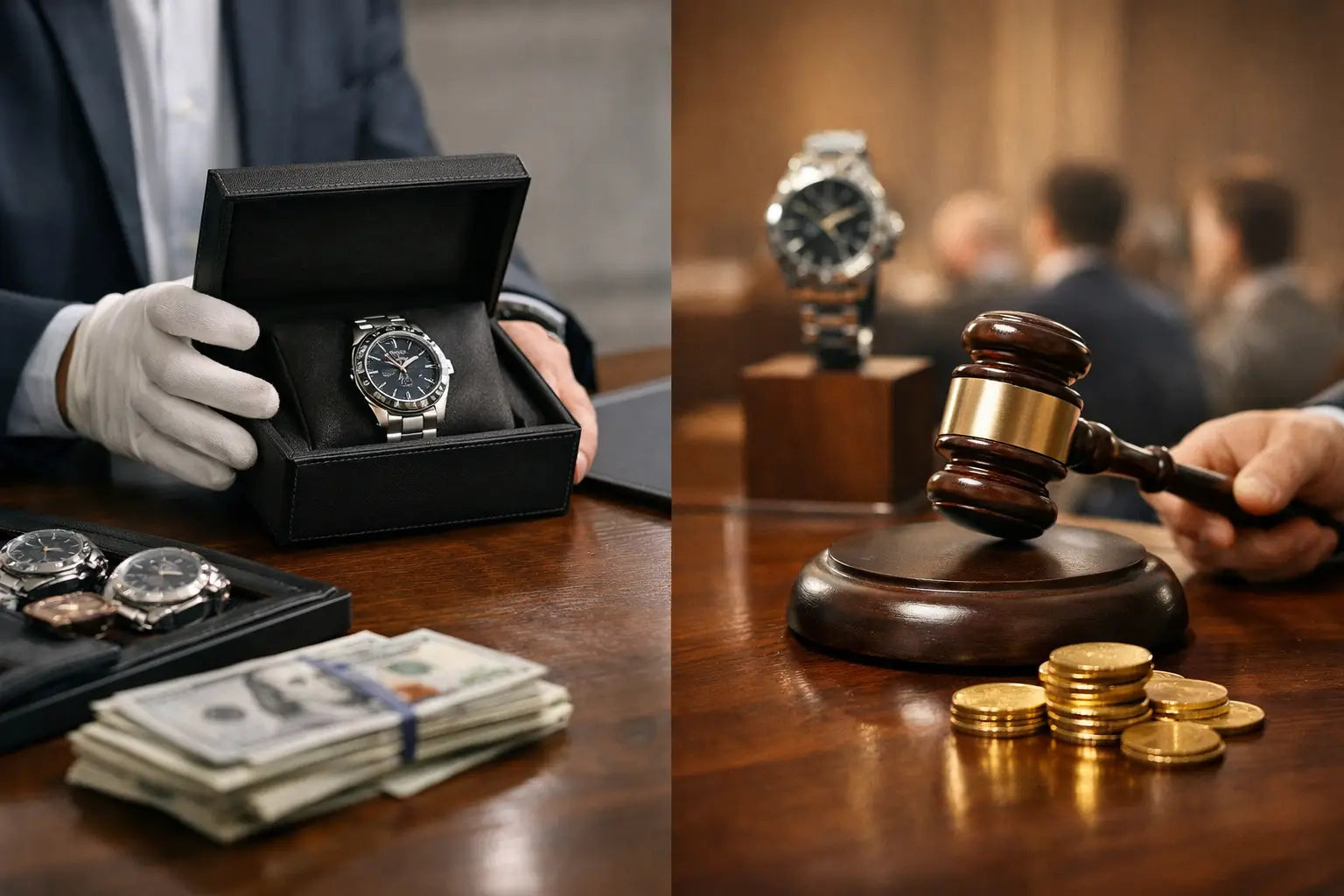
A Rolex Submariner, vintage Omega Speedmaster or inherited Patek Philippe can attract serious money, but the route you choose to sell it can change what reaches your bank account. Choosing a watch dealer or auction house is not simply a question of who gives the highest estimate. It is a decision about certainty, timescale, fees, risk and how much control you want over the final sale.
For many UK sellers, a direct specialist buyer is the cleaner option: a firm offer, no seller fees and payment as soon as the watch has been checked. Auctions can make sense for rare, historically important or genuinely unusual pieces, but they are slower and the headline hammer price is not normally the amount you receive.
Watch dealer or auction house: the key difference
A watch dealer buys your watch directly. After assessing the model, condition, service history, originality and current demand, they make an offer. If you accept, the transaction is complete once the watch is verified. A credible specialist will arrange insured collection or post, explain its process clearly and pay by bank transfer without leaving you exposed to a buyer changing their mind.
An auction house acts as an intermediary. Your watch is catalogued, photographed and offered to bidders on a set sale date. The final price depends on who participates, how they view the lot and whether the reserve is met. The auctioneer then deducts its seller's commission and any agreed charges before remitting the balance, often weeks after the sale.
Neither route is automatically right in every situation. The best choice depends on whether you value a guaranteed net figure now or are prepared to wait for the possibility of a stronger auction result.
What you actually take home
The most common mistake is comparing a dealer's offer with an auction estimate or hammer price. Those figures do not mean the same thing.
A dealer's offer should be the amount you receive, provided the watch matches the description and has not been affected by an undisclosed issue. Ask directly whether there are any deductions for payment, collection, authentication or administration. With a straightforward direct sale, there should be no surprise seller fees.
At auction, the hammer price is only the winning bid. Seller's commission is then deducted. Depending on the auction house and agreement, there may also be catalogue photography, insurance, withdrawal, storage or unsold-lot charges. Buyer premiums matter too: they raise the all-in price for the bidder, which can influence how far bidding goes.
Take a watch that sells for a £10,000 hammer price. If the seller's commission is 15%, your proceeds are £8,500 before any additional charges. A direct dealer offer of £9,000 may therefore be the better financial result, even though it looks lower beside the hammer figure.
The calculation becomes more nuanced with a highly sought-after reference. A rare Patek Philippe, an early Rolex with exceptional provenance or a collectible independent watch may draw competing bidders beyond its normal trade value. That upside is real, but it is never guaranteed.
Speed and certainty have a value
A direct sale suits owners who need a known result without a long selling process. This is often the case with an inherited watch, a collection being reorganised, or a watch being sold to fund another purchase. Once the valuation is agreed and the piece inspected, specialist buyers can commonly pay on the same day or within 24 hours.
An auction timetable is built around catalogue deadlines and scheduled sale dates. You may wait several weeks for the auction, then additional time for the buyer to pay and the auction house to process your proceeds. If the lot does not sell, you must decide whether to lower the reserve, enter it into another auction or collect it and start again elsewhere.
That delay is not necessarily a problem for a rare watch with a compelling story. It is a poor fit for a standard modern watch with a deep, established market. A current-production Rolex Datejust, Omega Seamaster or Tudor Black Bay normally does not need an auction room to find a buyer. A specialist dealer already knows the current market and has an active network of collectors and customers.
Condition can alter the outcome in either channel
Your watch's reference number is only the starting point. Originality, condition and completeness can materially affect the offer or auction interest. A full set with the correct box, warranty card, links, paperwork and recent service records will usually be easier to value and sell. For vintage watches, original dials, hands, bezels, bracelets and case condition can matter far more than a polished appearance.
A good dealer will explain the factors behind the valuation rather than quote a headline number without context. That is particularly valuable for older Rolex, Omega, Cartier and Breitling pieces, where replacement parts, refinishing and missing provenance can affect demand.
Auction catalogues can create attention around exceptional condition or documented provenance. However, a condition issue discovered during cataloguing may lead to a reduced estimate, a cautious reserve or a lot description that makes bidders more reserved. Transparency protects everyone, but it can also make the outcome less predictable.
Risk, security and seller effort
Selling a valuable watch privately can involve fraud attempts, chargebacks, disputes and uncomfortable meetings with strangers. Both reputable auction houses and established dealers remove much of that exposure, but the experience differs.
With a direct specialist buyer, the process should be controlled from start to finish. You should know where the watch is going, how it is insured, who is inspecting it and when payment will arrive. If you are not near London, insured postal arrangements can make a professional sale possible without travelling or meeting an unknown buyer.
An auction house adds a layer of formality and can be especially reassuring where a watch needs an expert catalogue entry. Yet you still need to understand the consignment agreement before handing the piece over. Check the reserve, the commission rate, insurance cover, withdrawal terms, payment timing and what happens if the watch remains unsold.
Direct dealers also vary widely. Avoid businesses that will not provide a clear company identity, use vague phrases such as "up to" without assessing the watch, or ask you to send an uninsured timepiece with no written process. A serious buyer is happy to discuss the model, condition, paperwork and practicalities before you commit.
When an auction house may be the better route
Auction is worth considering where the watch is rare enough to create competitive bidding rather than simply attract a single market price. This might include a limited-production independent, a historically significant military watch, a signed dial with strong provenance, or a rare vintage reference in original condition.
It can also work for watches with a story that a catalogue can document properly: a known original owner, period photographs, original sales receipts or a recognised collection history. In these cases, the auction house is selling context as well as the object.
Set a realistic reserve. An ambitious reserve can protect you from an unwanted low result, but it may discourage bidding or leave the watch unsold. Ask the specialist valuing the watch to distinguish between an achievable market figure and an optimistic estimate designed to win your consignment.
When a watch dealer is the stronger choice
A specialist dealer is usually the sensible option when the watch is liquid, you want a firm outcome quickly, or you do not want fees eroding the final amount. It is also well suited to owners who value privacy. A direct sale does not require your watch to appear in a public catalogue or sit through a lengthy auction cycle.
This route is particularly practical for modern Rolex, Omega, Tudor, Cartier, TAG Heuer and similar sought-after brands, as well as collections containing a mixture of luxury, vintage and enthusiast pieces. Rather than splitting items across several sales, a broad-market buyer can assess the collection as a whole.
Watch Nest provides free, no-obligation valuations and can buy directly with fully insured arrangements and fast bank-transfer payment. For sellers who are not under time pressure and want to pursue a higher retail-level return, consignment may offer a middle ground between an immediate purchase and the uncertainty of auction.
Ask for a net comparison before deciding
The right decision becomes clearer when you compare like with like. Obtain a direct purchase offer from a watch specialist, then ask an auction house to state its estimate, reserve recommendation, all seller charges and expected payment date in writing. Compare the guaranteed net dealer figure with the likely auction net figure, not the most flattering number in either conversation.
If the auction route only wins on a best-case scenario, while the dealer provides a strong market-aligned offer with no fees and immediate payment, certainty may be worth more than the wait. If your watch is genuinely scarce and has the provenance to make collectors compete, giving the market time may be justified.
The strongest sale is not always the one with the biggest headline number. It is the one that leaves you with a fair return, a clear process and complete confidence in where your watch has gone.