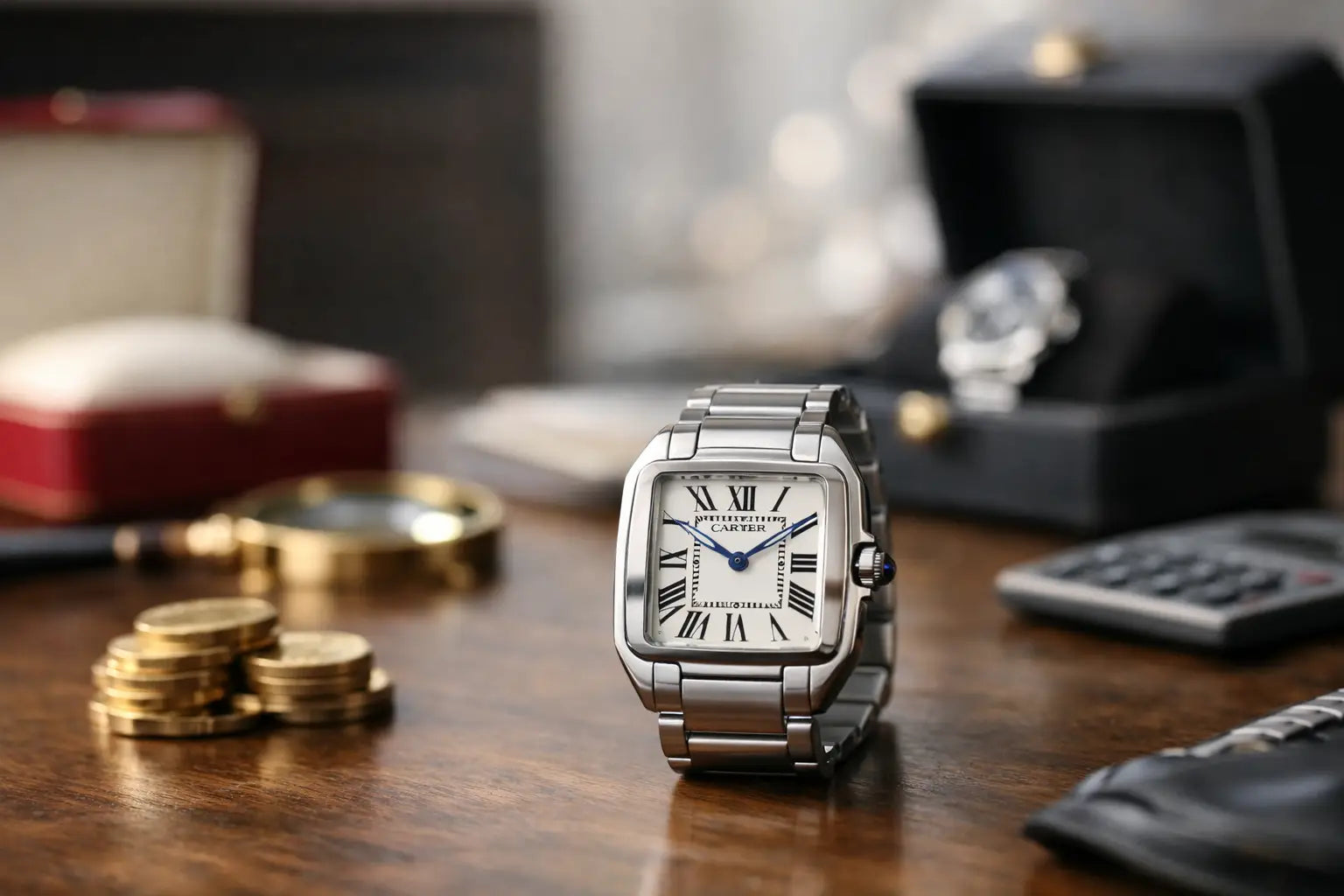
A Cartier is one of the few luxury watches people recognise across a room. That visibility matters when you come to sell, but so does the detail. Cartier watch resale value can be strong, particularly for sought-after Santos, Tank and certain Ballon Bleu references, yet the gap between an average offer and a well-supported market valuation can still be significant.
If you are selling a Cartier, the first thing to understand is that brand prestige alone does not guarantee top resale. Buyers look at model, size, metal, age, condition, service history and whether the watch is easy to place back into the market. A steel Santos with full set paperwork may attract very different buying interest from a quartz Tank without box or papers, even if both carry the Cartier name.
What affects Cartier watch resale value?
Cartier sits in an interesting part of the secondary market. It is a major luxury name with genuine horological credibility, but buyer demand is still model-led rather than simply brand-led. That means the watch on your wrist matters more than the logo on the dial.
The strongest factor is usually reference desirability. Modern Santos models remain consistently liquid because they appeal to both first-time luxury buyers and established collectors. Tanks also have broad demand, though values vary heavily depending on whether you have a Must, Solo, Louis Cartier or a more niche variation. Ballon Bleu watches can perform well, but some sizes and configurations move faster than others. Panthère demand is also healthy, especially among buyers looking for jewellery-led Cartier pieces.
Material matters as well. Stainless steel generally has the widest buyer base because it is easier to resell quickly at realistic market levels. Two-tone can be more selective. Full gold pieces often have higher headline values but narrower demand, which can affect how aggressively a buyer prices the watch. Diamond-set models are another case where retail pricing and resale pricing often sit far apart.
Movement type can also shift the result. Mechanical Cartier watches, especially automatic models from popular lines, tend to attract stronger enthusiast demand than quartz equivalents. That does not mean quartz Cartier watches are poor sellers. Many quartz Tanks and Panthère models are highly desirable. It simply means the market is more reference-specific, and condition becomes even more important.
Which Cartier models hold value best?
When people ask about Cartier watch resale value, they usually want to know whether their model sits in the stronger part of the market or the softer part. In broad terms, the Santos is often among the easiest Cartier watches to sell well. The design is iconic, modern references are highly wearable, and demand stays relatively consistent.
The Tank family is more complicated. Certain Tank Must and Tank Solo models offer good resale relative to their original positioning, while precious metal Tank Louis Cartier watches depend more on exact size, dial layout and overall condition. Vintage Tanks can also perform very well, but only when the watch is correct and appealing to informed buyers.
Ballon Bleu models retain demand because the shape is instantly recognisable and Cartier has marketed the line successfully for years. Even so, resale can vary sharply between ladies' quartz pieces, larger automatic references and precious metal versions. The same principle applies to Panthère. It is a strong name with excellent recognition, but the best results usually come from well-preserved, correctly sized examples with complete accessories.
Less common Cartier ranges can still be saleable, but they may need a more specialist audience. That can reduce speed and tighten direct purchase offers. If a watch is uncommon, unusual or older, the right route to sale becomes just as important as the watch itself.
Why box, papers and condition matter so much
In the Cartier market, completeness supports confidence. A watch with original box, warranty card or papers, booklets and service documents is easier for a buyer to authenticate, price and resell. That typically strengthens offers, particularly for newer pieces.
Condition is just as important, but there is nuance here. Light wear is normal and rarely a major issue. Heavy polishing, bracelet stretch, dial damage, replacement parts or poor aftermarket work can be more serious. Cartier buyers often care about how crisp the case lines remain, whether the bracelet is tight, and whether the watch still presents as authentic and unspoilt.
An old service can still be useful evidence, but a recent manufacturer or respected specialist service carries more weight. If the watch has a fault, do not try to hide it. A professional buyer will find it during inspection, and transparency early on tends to produce a smoother, faster transaction.
Cartier retail price versus real resale price
One of the most common mistakes sellers make is anchoring on current Cartier retail. Retail tells you what it costs to buy new from a boutique. Resale tells you what the secondary market is willing to pay for your specific watch today.
That difference can be wide. Some Cartier watches hold value very well, especially if supply is tight and demand is broad. Others may sit much lower than owners expect because the pre-owned market has more stock, less urgency or lower demand for that exact size or specification.
The route you choose also affects what you take home. A private sale might produce a higher headline price, but that figure often ignores marketplace fees, time wasters, fraud risk, payment disputes and the delay involved in finding the right buyer. Auction can work for rare or highly collectible pieces, though fees and uncertainty can reduce the final net return. A direct specialist sale usually offers speed, security and clarity. Consignment can make sense if you are not in a hurry and want to aim for a stronger result.
How buyers value a Cartier watch
Professional buyers do not value Cartier watches by guesswork. They look at recent trading evidence, current demand, stock levels, serviceability and how quickly the watch can be reintroduced to the market. A realistic offer reflects not just what the watch is worth in theory, but what it is likely to achieve in practice.
This is why online estimate tools and forum chatter can be misleading. They often miss regional demand, dealer appetite and the condition-specific adjustments that matter in real transactions. Two apparently identical Cartier watches can receive noticeably different offers once originality, wear and completeness are taken into account.
For UK sellers, there is also value in dealing with a buyer who understands the domestic market properly. Local demand, payment expectations and insured handling all affect the real-world selling experience, not just the price on paper.
How to improve your Cartier watch resale value before selling
The simplest way to protect Cartier watch resale value is to present the watch properly and gather everything that supports it. Locate the box, papers, spare links, receipts and service records before requesting a valuation. Wipe the watch clean, but avoid amateur polishing or cosmetic work that can do more harm than good.
Take clear photographs in natural light. Show the dial, caseback, clasp, bracelet, crown and any accessories. If there is damage, include it. Serious buyers prefer accurate information to flattering angles.
It also helps to be realistic about timing. If you need funds quickly, a direct purchase route is often the best fit. If your Cartier is scarce, vintage or especially collectible, a consignment approach may be worth considering. The best option depends on whether your priority is speed, certainty or squeezing out the final margin.
When is the best time to sell a Cartier?
There is no perfect universal moment, but there are better and worse conditions. Strong fashion visibility, rising Cartier retail prices and sustained demand for iconic models can all support resale. On the other hand, oversupply in a specific reference can soften offers, even when the wider luxury watch market looks healthy.
The practical answer is simple. Sell when your model is in demand and when your own priorities line up with the route available. Waiting for a theoretical peak often backfires, especially if the watch sits unworn while market appetite shifts.
If you want a quick, secure and market-aligned sale, expert appraisal matters more than hopeful pricing. Watch Nest, for example, sees first-hand how much variation there is between Cartier references that look similar to non-specialists but trade very differently in the real market.
A Cartier is rarely difficult to sell. Getting the right result is the harder part. The owners who do best are usually the ones who understand that resale value is not just about the name on the dial, but about choosing the right buyer, the right pricing expectation and the right route to market.