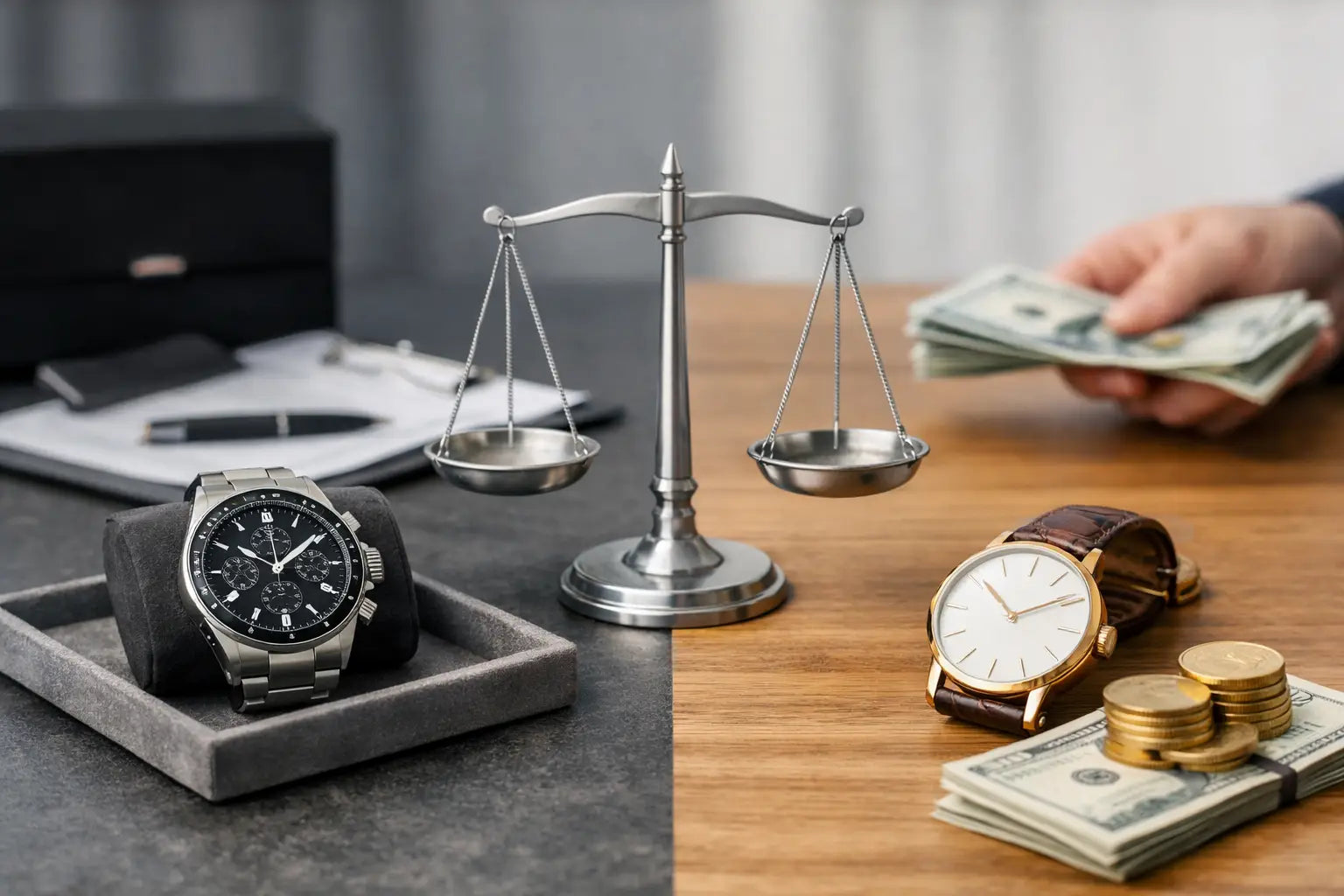
A Rolex Submariner, Omega Speedmaster or inherited vintage watch can attract very different offers depending on how you sell it. The choice between consignment or direct watch sale is not simply about the highest headline figure. It is about how quickly you need the money, who carries the risk, what fees apply and how much control you want once the watch leaves your hands.
For some owners, a direct sale is the sensible commercial decision: one firm offer, a secure handover and cleared funds the same day or within 24 hours. For others, consignment can produce a stronger final return if they can wait for the right buyer. Knowing where the difference lies prevents an expensive mistake.
Consignment or direct watch sale: the key difference
A direct watch sale means a specialist buys your watch from you outright. Following an appraisal, you receive a fixed offer based on its condition, originality, service history, box and papers, current demand and comparable market transactions. Once you accept, the buyer owns the watch and pays you promptly.
Consignment means the dealer sells the watch on your behalf. The watch is photographed, marketed, shown to prospective buyers and sold at an agreed retail price or within an agreed range. The dealer deducts their commission and any agreed costs after the sale, then sends you the balance.
The direct route prioritises certainty and speed. Consignment prioritises the potential for a higher net figure, but there is no guaranteed completion date. Neither option is automatically better. The correct choice depends on your watch and your circumstances.
When a direct sale makes more sense
A direct sale is usually the strongest option when timing matters. Perhaps you are funding another purchase, handling an estate, reducing a collection, or simply do not want a valuable watch sitting in someone else’s stock for weeks or months.
With an established buyer, the process is straightforward. You provide the watch details and photographs, receive a valuation, arrange an in-person appointment or insured postal delivery, and receive payment once the watch has been checked. There are no marketplace listings to manage, no strangers requesting meetings, and no buyer attempting to renegotiate after delivery.
This route also makes sense where the market is uncertain. Watches that were trading at unusually high prices can correct quickly when supply rises or collector demand cools. A confirmed direct offer removes the risk of waiting for a theoretical retail figure that may no longer be realistic by the time a buyer appears.
A direct buyer also takes on the work after purchase. They must prepare the watch, stand behind its authenticity, manage any customer questions and carry the commercial risk if it takes longer to sell than expected. That risk is one reason a direct offer will normally be below the dealer’s eventual retail asking price.
That does not mean it is a poor price. The figure to assess is your net return. A strong direct offer with no seller fees, no payment delay and no further obligations can compare very well with a higher consignment asking price once commission, time and possible reductions are considered.
When consignment can produce more
Consignment is often worth considering for watches with a clear collector audience and a realistic prospect of achieving a premium retail price. This may include a desirable Rolex reference with a strong full set, an uncommon Patek Philippe, a sought-after Audemars Piguet, a period-correct vintage piece, or a limited-production independent or microbrand watch.
The key advantage is access to the dealer’s retail customer base. A specialist can present the watch professionally, verify it, answer technical questions and offer buyers the confidence that private listings often lack. That can support a better sale price than an owner may achieve alone.
However, consignment should be judged on the expected net proceeds, not the advertised price. If a watch is listed at £10,000 and the dealer’s commission is 10 per cent, your return is £9,000 before any other agreed charges. If the watch later needs to be discounted to secure a buyer, your return may reduce further.
Ask what happens if the watch does not sell within the agreed period. Can the price be reviewed? Can you collect the watch without a charge? Is there a minimum amount you must receive before a sale can proceed? Clear answers matter, particularly for watches where condition, dial originality or provenance can make a substantial difference to value.
The real calculation: price, time and certainty
It is easy to compare one large number with another and assume consignment wins. A more useful comparison looks at four commercial factors.
First, consider the net amount you will receive. A direct offer is usually the amount paid to you. A consignment figure may be a retail target before commission, insurance, preparation costs or any agreed discounting.
Second, put a value on time. If you need funds this week, an attractive consignment valuation for a sale several months away may not be useful. Conversely, if you are under no pressure and own a watch with strong collector appeal, waiting may be a reasonable trade-off.
Third, establish who bears the risk. In a direct sale, the buyer takes the risk once the transaction is complete. On consignment, you need to understand whether the watch remains insured at all times, how it is stored, and whether it can be sent to clients or events.
Finally, consider the effort required from you. Private selling can appear to offer the highest return, but it can bring listing fees, payment fraud concerns, chargeback disputes, timewasters and uncomfortable meetings. Both direct sale and consignment through a reputable specialist remove much of that friction, but direct sale is usually the simpler of the two.
Questions to ask before choosing consignment
Before placing a watch on consignment, get the arrangement in writing. A professional agreement should state the minimum net payment you will receive, the commission percentage, the initial asking price, the consignment period and whether the dealer may reduce the price without your approval.
You should also confirm insurance. Ask whether the watch is covered for its full agreed value while in storage, in transit and when being shown to a prospective buyer. If the watch is lost, damaged or stolen, the agreement should make the claims process and your entitlement clear.
Payment timing is equally important. Will you be paid immediately when the buyer pays a deposit, when their funds have cleared in full, or after any return period has passed? There is no universal answer, but there should be no ambiguity.
For vintage watches, discuss how originality will be described. Replacement dials, relumed hands, polished cases and non-original bracelets can all affect a collector’s view and the achievable price. Accurate representation protects both the seller and the eventual buyer.
How to improve either outcome
Whether you choose consignment or an outright sale, preparation can affect the valuation. Gather the original box, warranty card, purchase receipt, service papers, spare links and any provenance that supports the watch’s history. A complete Rolex, Tudor or Omega set will often command more confidence than the watch alone.
Do not polish or alter a vintage watch before seeking advice. A sharp case, original dial and honest patina can be far more valuable to collectors than an over-restored appearance. Similarly, avoid paying for a service purely to sell unless a specialist confirms that the likely uplift justifies the cost.
Provide clear photographs of the dial, case, bracelet, clasp, caseback and all accessories. Be open about scratches, timing issues, replaced parts or missing paperwork. An accurate initial description leads to a more reliable offer and avoids a frustrating revision later.
A practical route for UK watch sellers
If fast payment and a clean break are your priorities, request a direct purchase valuation first. It gives you a firm baseline and lets you decide whether the additional potential return from consignment is worth the delay. At Watch Nest, sellers can obtain a no-obligation valuation and choose an insured postal transaction or a face-to-face London appointment.
If the direct offer is close to the amount you hoped to receive, accepting it is often the commercially sensible choice. You have converted an asset into cleared funds without fees, public listings or an uncertain waiting period.
If your watch is rare, especially well preserved or likely to appeal to a specific collector, consignment may justify a longer timetable. Set a realistic price, agree your minimum return and make sure the dealer has the expertise and client base to sell that particular reference properly.
The best choice is the one that gives you a fair net price on terms you are comfortable with. A watch sale should not leave you guessing when you will be paid, what you will receive or who is responsible if something goes wrong.