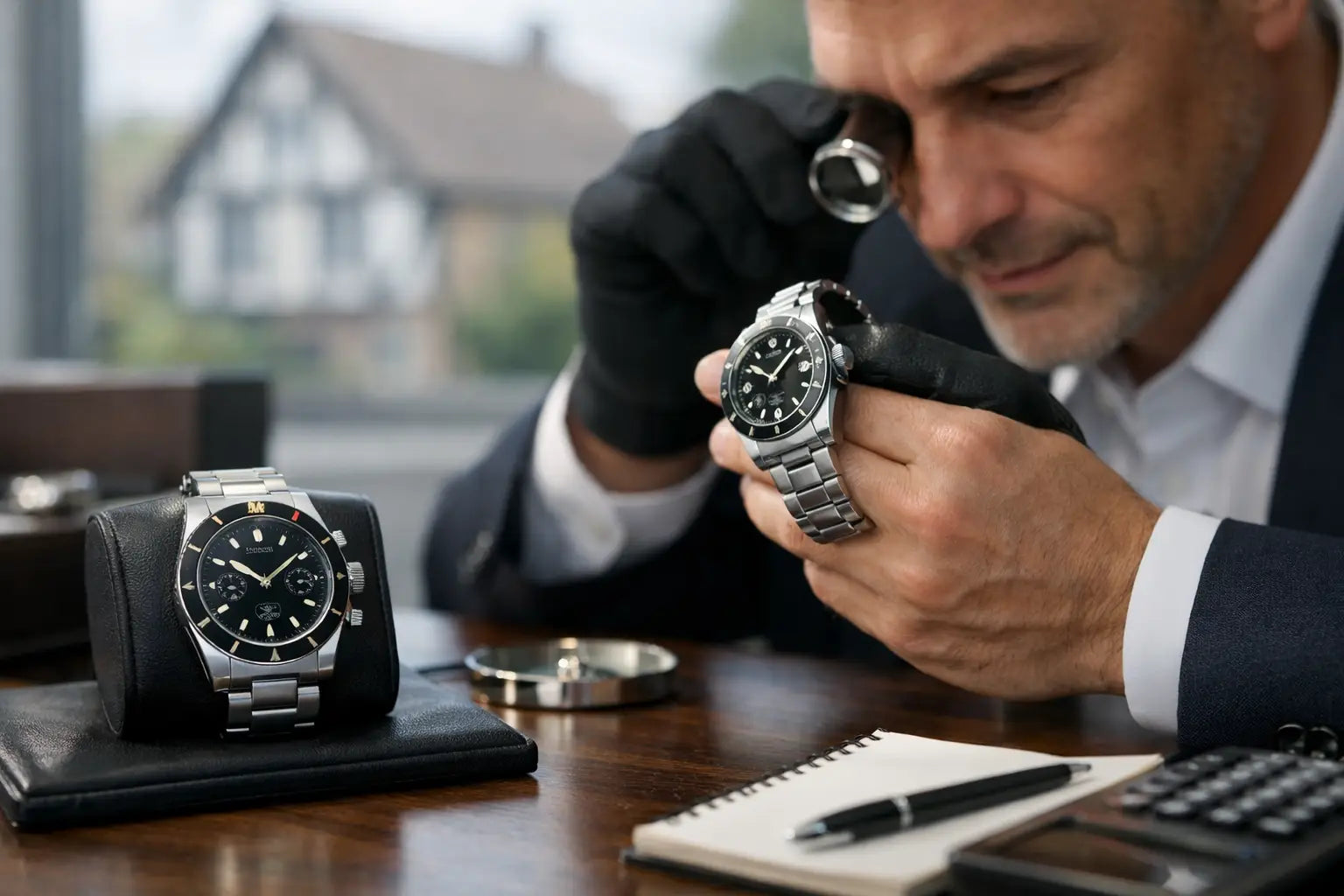
A Tudor Black Bay with box and papers can command a very different price from the same reference sold watch-only, and that gap is exactly why knowing how to value a Tudor matters before you accept any offer. If you are selling, insuring an inherited piece, or simply trying to understand what you own, the right valuation comes down to specifics, not guesswork.
How to value a Tudor in the real market
The quickest mistake sellers make is looking at a few online asking prices and treating them as market value. Asking prices are often optimistic. Real value is shaped by what buyers are actually paying now, after condition, accessories, service needs and resale demand are factored in.
Tudor sits in an interesting part of the market. It has strong brand recognition, serious enthusiast appeal and several modern references that are consistently liquid, but it is not valued in the same way as Rolex. Some Tudor models are easy to place and attract strong offers quickly. Others are more dependent on condition, originality or whether the reference still has active demand behind it.
If you want an accurate number, think in terms of saleable market value rather than headline retail or aspirational dealer pricing. That gives you a more useful basis whether you plan to sell outright or consign for a higher return.
Start with the exact Tudor model and reference
Valuation starts with identification. “A Tudor Black Bay” is not enough. Case size, bezel, dial colour, bracelet type and generation all affect price. A Black Bay Fifty-Eight, a Pelagos FXD and a Royal sit in very different parts of the pre-owned market, even if they appear broadly comparable to a non-specialist.
The reference number is usually the key. You will often find it on paperwork, a swing tag, the caseback on some models, or associated sales documents. Once the exact reference is confirmed, the next step is to place it in the current market rather than rely on what that model achieved a year or two ago.
This matters because Tudor values can move. The brand has had periods of very strong demand, particularly around Black Bay variants, Pelagos models and discontinued references. At the same time, more widely available pieces with weaker secondary demand can soften.
Modern Tudor models with stronger resale demand
In broad terms, the models that tend to perform best are the ones with established enthusiast demand and clear identity. Black Bay Fifty-Eight references, Pelagos models, Black Bay Pro, certain GMT variants and select discontinued or harder-to-source pieces often attract firmer pricing.
That does not mean other Tudors have no value. It means the market is more selective. A Tudor 1926 or Royal can still be a straightforward sale, but the spread between retail price and resale value may be more noticeable.
Vintage Tudor needs a different approach
If the watch is older, valuation becomes more nuanced. Vintage Tudor pricing is influenced by originality, dial condition, hand set, bezel insert, bracelet, service parts and provenance. A polished case, relumed dial or replacement handset can materially change what collectors are willing to pay.
This is where generic online estimates become less reliable. Two vintage Tudors with the same reference can sit far apart in value depending on originality and how well the watch presents.
Condition has a direct effect on Tudor value
Once the reference is confirmed, condition is usually the biggest pricing factor. Buyers do not just look at whether a watch works. They look at sharpness, finish, wear and whether anything has been altered.
A Tudor in excellent condition with a clean crystal, strong case lines, original dial and a bracelet with little stretch will normally attract stronger offers than an over-polished example with noticeable marks and missing links. Light wear is expected on used watches. Heavy cosmetic wear, corrosion, aftermarket parts or mechanical faults reduce confidence and therefore value.
Condition should be assessed honestly. Overstating it rarely helps because it will be corrected during inspection. A realistic description saves time and leads to firmer pricing.
Box, papers and accessories can move the number
Full sets usually perform better. Original box, warranty card, booklets, spare links, swing tags and receipts all support the watch’s provenance and make it easier to resell. For modern Tudor models in particular, papers can make a meaningful difference.
That said, missing accessories do not automatically make a watch hard to sell. A desirable Tudor without box and papers can still attract a good offer if the watch is genuine, in strong condition and correctly identified. The difference is usually in where the final price lands within the market range.
If you are unsure whether accessories matter, assume they do. Even small items such as extra bracelet links affect value because replacing them later adds cost.
Service history matters, but not always in the same way
A recent Tudor service can support value because it reduces the buyer’s immediate risk. If the watch has been serviced by Tudor or a respected independent specialist and paperwork is available, that tends to help.
But service history is not a simple yes or no. On a modern piece, a documented recent service is usually positive. On a vintage watch, collectors may care just as much about what was replaced during service. Original tritium dial and hands, original crown or bezel insert can be more valuable than service replacements.
So when assessing how to value a Tudor, ask not only whether it was serviced, but what that service involved.
Market timing and buyer demand affect what you can achieve
The pre-owned watch market is not static. Demand moves by model, season and wider sentiment. A watch that looked strong six months ago may be flatter today if supply has increased. Equally, a discontinued Tudor with growing collector interest may outperform expectations.
This is why sold market evidence matters more than old forum chatter or stale listings. Current buyer appetite determines liquidity. Liquidity then influences the strength of a direct purchase offer.
If speed matters, expect the price to reflect that convenience. If maximising return matters more and you are prepared to wait, consignment can sometimes achieve a better result. The right route depends on your priorities.
How to value a Tudor if you plan to sell
If your goal is an actual sale rather than a rough estimate, valuation should be practical. Start with the exact reference, photograph the watch clearly, gather any box and papers, and note service history or faults. A proper appraisal can then place the watch in a realistic selling bracket.
At that point, it helps to distinguish between three different numbers. There is the optimistic asking price you may see online, the likely retail resale price from a dealer, and the direct buying price a professional buyer may offer for a fast, secure transaction. These are not the same figure, and confusion between them is where many sellers go wrong.
Private selling can sometimes produce a higher top-line number, but fees, risk, delays and buyer disputes often narrow the advantage. A direct specialist sale is normally lower than full retail, but faster, more secure and easier to complete. For many sellers, especially with high-value watches, that trade-off is worth making.
Common reasons Tudor valuations come in lower than expected
The gap between expectation and offer is usually explained by one of a few issues. Sellers often compare their watch with unworn dealer stock rather than used market evidence. Some assume the original retail price sets a floor, which it does not. Others overlook polishing, missing accessories, overdue servicing or weaker demand for a specific configuration.
Another common issue is aftermarket modification. Replacement straps are usually not a problem if the original bracelet is included, but aftermarket dials, hands, bezels or non-standard parts can reduce buyer confidence sharply.
A fair valuation is not about finding the highest number available anywhere. It is about identifying the price a knowledgeable buyer will actually pay for your exact watch now.
Getting an accurate Tudor valuation without wasting time
The most efficient route is a specialist assessment based on photos, reference details and accessories, followed by physical inspection if needed. That gives you a market-aligned range quickly and removes the noise created by random listings and speculative forum opinions.
For sellers in the UK, using a professional watch buyer also reduces the usual friction. You avoid marketplace fees, no-show buyers and payment uncertainty, and you get a clearer answer on what your Tudor is worth in today’s market. Watch Nest takes this approach because it is faster, more transparent and more useful to sellers than inflated headline estimates.
If your Tudor is especially rare, vintage or unusual, expect the valuation process to be more detailed. That is not a red flag. It is usually a sign the appraiser is doing the job properly.
A Tudor is only worth what the market will pay for that exact watch in its current state, with its current demand. Get the reference right, be honest about condition, include every accessory you have, and treat valuation as a real market exercise rather than a hopeful estimate. That is how you sell with confidence and without leaving money on the table.